Build Your Skills

Once your transition goal is set, and you and your caregivers have started the administrative processes to access required supports in the community, an important step is to evaluate your current skills and abilities to determine if there are any skill deficits or gaps that might ultimately affect your success in the community pathway. This self-assessment can be completed through self-reflection, discussions with key supporters (including caregivers and educational, community, and medical supports), and/or through the evaluation process with Developmental Services Ontario (DSO).

The skills students rely on to live and participate in the community are sometimes called “life skills” or “independent living skills.” Here are some checklists to rate your skills and to determine areas that may need strengthening or improvement.
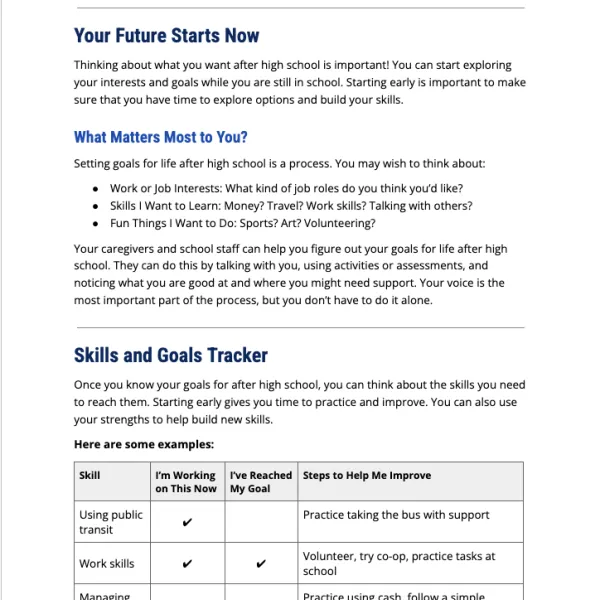
While everyone’s personalized skill development plan will look different, there are some common challenges that people in the Community Pathway often face. As such, this area will outline common areas of challenge and provide some ideas about resources and strategies that might be useful to strengthen your skills. Some key skills that help people thrive in this pathway include:
You can begin building the skills and abilities to promote independence long before you graduate. The goal is to develop confidence and comfort using required skills—with the support you need. These types of goals should be outlined in your high school Individual Education Plan (IEP), often through the development and implementation of alternate learning goals.
We will start by discussing the importance of building specific skills and provide some guidance and resources on how to start practicing these abilities, while also pointing out some websites and resources that your teachers, parents, and disability-related service workers can use to support your skill developments.

While, at first glance, the list of skills to build might seem overwhelming, by starting early you will have time to slowly build and practice these skills prior to the transition to adulthood. Having already discussed your long-term goals, your supporters can help you link specific skills to future outcomes, to help promote motivation. Prioritizing tasks according to your interests can also be beneficial, starting with one or two goals. Further, you may want to make sure that your goals are SMART, meaning that they are Specific (create a clear and concise goal), Measurable (ensure you can measure progress), Achievable (ensure you can achieve the goal), relevant (short-term goal aligns with your long-term goal), and time-bound (make sure that your goal has a time frame for achievement).

The transition from secondary school to the Community Pathway means a change in how people interact with others (outside of their school or home) on a day-to-day basis. Whether in the workplace, a volunteer role, in community programming, and/or living with others outside your family, interacting with new people will require a new set of skills and abilities.
The process of learning to understand one’s own strengths, challenges, and preferences, then communicating those insights effectively, is often described as self-advocacy. It combines self-awareness and communication skills, enabling a person to express their viewpoints, make informed choices, and seek support when necessary. Self-advocacy focuses on having a seat at the table, being heard, and taking part in decisions that impact one’s everyday life.
For many people, self-advocacy begins with noticing your personal needs and preferences through self-reflection and talking to trusted supporters. For example, some people learn best with visual aids or short verbal instructions. Others prefer a structured environment to navigate social or learning tasks. Some use specialized communication methods, such as digital resources or pictures to express their needs. Recognizing these personal patterns is a crucial first step in advocating for yourself, whether in the classroom, workplace, or community setting.
Strategies to help you identify your needs and preferences include:
Once you have this information, it is often helpful to produce a written document to not only help with your thinking but also to allow you to easily communicate the information to others. As your Individual Education Plan (IEP) from high school won’t follow you into the adult world, it is often helpful to develop a one page “cheat sheet” for those you will be working with in the community to understand you. While it doesn't replace building a true relationship, it creates the opportunity for someone to start off on the right foot so they are able to build and grow a relationship and work with you effectively from the start.
Remember, the One Page Profiles (a one-page summary of strengths and needs and the associated strategies/learning methods/environmental supports that help you succeed) are working documents—meaning they are ever-evolving and always changing... just like you!
How Do I Create a One-Page Profile?
In addition to creating a one-page resource to communicate your needs and preferences, being able to communicate with a wide variety of individuals in the community is an important skill for everyone. Improving communication may involve working with a speech and language pathologist, using alternative communication devices, or practicing social scripts. Developing the ability to convey one’s thoughts, feelings, and questions increases the likelihood that others will listen and respond with helpful support.
How do you build this skill?
Understanding how to stay safe in different environments is an essential part of becoming more independent. Safety skills can include knowing what to do in an emergency, identifying trusted people to ask for help, and recognizing unsafe or uncomfortable situations. Learning safety strategies gives people greater confidence and freedom while also providing peace of mind to families and caregivers.
Safety planning often involves a mix of environmental supports, supervision, and personal awareness. For example, some people may benefit from technology supports like GPS tracking or emergency call buttons, while others may need practice following a “what if” plan when encountering an unfamiliar situation. Teaching these skills early—and reinforcing them regularly—helps build habits that keep the person safe both at home and in the community.
Ways to Improve Safety
Additional resources to improve safety in the home can be found here.
Everyone experiences big emotions, but learning to express and regulate them safely is key to well-being and independence. Emotional regulation helps people recover from stress, interact positively with others, and make healthy choices. For people with developmental or intellectual disabilities, this skill develops through consistent routines, supportive coaching, and practice in real-life contexts.
How to build this skill:
Once foundational skills are built, some may move on to using more advanced independent living skills.
EDIT THIS INTRODUCTORY PARAGRAPH
Advanced skills for success focus on building the routines, responsibilities, and practical life skills needed to live with greater independence in the community. These skills support confidence, reduce stress, and help make everyday life more predictable and manageable. By developing consistent routines, self-care habits, household skills, transportation awareness, and money management strategies, individuals can strengthen their ability to navigate daily life and move toward their goals with greater independence and self-direction.
Building consistent daily routines supports independence and reduces anxiety. Routines make transitions predictable and help people take ownership of their day.
How to build this skill:
Self-care is more than hygiene—it includes health management, rest, and emotional well-being. These skills promote confidence and autonomy.
How to build this skill:
For more strategies and resources related to self-care skills, go to the following resource.
Contributing to household responsibilities teaches valuable life skills and a sense of accomplishment.
How to build this skill:
For more strategies and resources related to household living, go to the following resource.
Understanding money promotes self-reliance and decision-making. Financial literacy can begin with small experiences and grow over time.
How to build this skill:
For more strategies and resources to build budgeting and money knowledge, go to the following resource.